
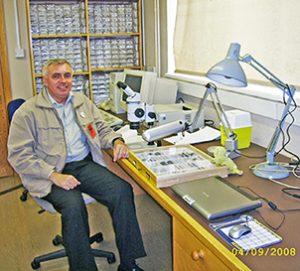
These years have not been productive. The page contains only 8 publications. On the other hand, there were many methodological editions, which should be indicated in a special list, and are not here. However, one textbook is present.
Photo: Great Britain, Oxford,
Museum of Natural History
Oxford University
04.09.2008
2016 year
Shatrovskiy, A. (2016) Zoning in the nomenclature of areals of the family of water scavenger beetles (Coleoptera: Hydrophilidae). Ukrainian Entomological Journal. № 1–2 (11). С. 85–90. (In Ukrainian)
On the base of material processed by the author, detailed information is given on the distribution of two species of the water scavenger beetles: Laccobius decorus (Gyllenhal, 1827) and Cercyon impressus (Sturm, 1807). The possibilities of using different approaches to the nomenclature of disjunctive areals of species confined to azonal landscapes are discussed. It is proposed to add a biotopic characteristic to the traditional name of the area.
I have a special attitude to the disjunctive areals. For some species, I establish this type, instead of the existing opinion of continuous distribution. But since the opportunity arose, I decided to formulate a new approach to the nomenclature. This was prompted by the fact that in zoogeography there was a tendency to form compound names by adding more and more definitions to them. In addition, the existing nomenclature indicates only a zonal distribution, and if the species is occurred in biotopes that are met here as azonal or intrazonal (like most scavenger water beetles), then a discrepancy with the nomenclature is obtained. So I proposed just a small addition: to include biotopes in the name of the areas. That’s all!
Shatrovskiy, A. (2016) Practical application of eco-ethological classification of the fishes. Problems of Zooengineering and Veterinary Medicine. Iss. 32. pt. 1. P. 250–257. (In Ukrainian)
The great practical value of eco-ethological classification of fishes is reasonable for researches in ichthyology, fish-farming and for researches of bioresources. Being considered in the comparison the eco-ethological classification of fishes by S. Kryzhanovskiy and by E. Balon provides importance of the use of the newest classifications and their introduction into practice.
I wrote this work because I can hardly accept in detail the classification of Balon. Namely, this system is the most common in international projects. But Balon himself wrote that he based it on Kryzhanovsky’s approach. That’s what I wanted to develop. The resulting classification is more harmonious and less formalized (I say this with confidence, because it is not mine ones).
Shatrovskiy, A., Kravchenko, A. (2016) Towards the study of the beetles of the families Helophoridae, Hydrochidae, Spercheidae, Hydrophilidae, Hydraenidae, Elmidae, Dryopidae and Heteroceridae (Coleoptera) of Shatsky National Nature Park. Kharkov Entomol. Soc. Gazette. Т. XXIV, iss. 1. P. 45–61. (In Ukrainian)
The results of long-term researches on the territory of Shatsky National Natural Park are presented. Material was collected in 35 basic points. Researches are covered all types of aquatic and semi-aquatic biotopes presented in a park. 70 species of beetles from superfamilies Hydrophiloidea (families Helophoridae, Hydrochidae, Spercheidae, Hydrophilidae), Staphylinoidea (family Hydraenidae) and Byrrhoidea (families Elmidae, Dryopidae and Heteroceridae) have been found. Three species (Berosus geminus Reiche et Saulcy, 1856, Berosus frontifoveatus Kuwert, 1888 and Cercyon subsulcatus Rey, 1885) are firstly indicated for territory of Ukraine. For each of the found species places of collections and number of specimens are given, data on biotopic preferences in the Shatsky NNP are generalized. Data on phenology of species on the territory of Shatsky NNP are given and generalized. For adjacent territories of Poland and Belarus 144 species from the studied families on the base of literary sources are mentioned. 70 species of them are not found yet in Shatsky NNP, but may be detected during further researches. Coefficients of likeness of Shatsky NNP fauna with fauns of adjacent territories of Belarus and Poland are calculated. The most similarity of local fauna is evaluated for fauna of Woodlands (Podlasie) and Lubelska upland in Poland. The least similarity is evaluated with the fauna of Rostocze lowland.
After 40 years since we met with Sasha Kravchenko, we finally got a joint ecological-faunal work that we can be proud of. They relied only on the collected material. Sasha intensively collected about 10 years before publication, I worked with him in the field in August 2015. The paper also provides a list of species that are probably occurred in the Shatsky Park. And since then – some of them have already been found. But no one knew that in three years foreign colleagues from the Balfour-Brown Club would come here and make new finds.
Shatrovskiy, A. (2016) Evolutionary morphology as a methodological basis of biological education in the field of animal husbandry. Methodical improvement of the educational process: Scientific and methodical bulletin. Issue. 4. Khark. State Zoovet. Academy Kharkiv.: KhSZVA. P. 92–97. (In Ukrainian)
Text is not available now
In the article I “punched through” the structural-evolutionary approach in the methodology of teaching biology. Unfortunately, the publication is not available to me at the moment.
2015 year
Shatrovskiy, A. (2015) Structural hierarchy of natural systems in the methodology of entomological research. Kharkov Entomol. Soc. Gazette. V. XXІII, iss. 2. P. 5–13. (In Russian)
The variant of organization of the natural systems in four functional rows, divided into structural levels on hierarchical principle, is presented. Character and directions of relationships between the systems in consist a biosphere are grounded. Structures of biontic and geocoenotic rows are considered in detail. In consist of biontic row ways of metaevolution and symbiogenesis are identified, their directions are represented. The place of insects is shown in a natural hierarchy and their possible relationships are reasonable with the bionts of other levels. The hierarchy of the systems of geocoenotic row is examined as basis for the creation of database in entomological researches. Discussed the variant of database made by the author in Microsoft Access, containing information on taxonomy, geographical distribution and ecological characters for the beetles of superfamily Hydrophiloidea. The used variants of the systems of bioorbises, natural zones, landscapes and ecosystems levels are offered. Hierarchical constructions are used for classification of aquatic habitats, including their division on mesohabitats.
I wrote this article to approve the structural-functional hierarchy (proposed in my publication 15 years ago) as a universal tool in the methodology of natural science research. Sasha Drogvalenko gave the idea of creating a database into practice for working with collections. It remains for me to expand the range of variables and reorganize the structure. We are both committed to using standard Microsoft programs to store information.
Another colleague who influenced the decision was Andrew Przhiboro. His report in Borok (2013) on the distribution of aquatic dipterian larvae across macrobiotopes expanded my understanding of the structure of aquatic ecosystems. Andrei provided me with links to the work of foreign colleagues, which he mentioned in the report.
… It’s been seven years. The system continues to work in a little-modified form, and never did not fail.
Shatrovskiy, A. (2015) Micragasma Sahlberg, 1900 (Coleoptera: Hydraenidae) a new genus of halophilic water-walkers for Ukraine. Kharkov Entomol. Soc. Gazette. V. XXIII, iss. 1. P. 13–15. (In Russian)
First record about location of the genus Micragasma Sahlberg, 1900 in Ukraine. Data on nomenclature, morphology, biology and distribution of M. paradoxum Sahlberg, 1900. Differentiated diagnosis of genus and species, figures of male genitalia, map of distribution are presented.
The second job for which I am indebted to Sasha Drogvalenko. I consider it my mistake that I did not include him as a co-author. After all, the material was collected by him, and he correctly identified the genus and species. I hope to pay off my debt. Time has not yet expired.
For some reason, my “differentiated” diagnosis became “differential” in the publication. This is an author’s mistake. Missed.
2014 year
Shatrovskiy, A. (2014) New data on little-known Crimean endemic species Hydraena jailensis Breit, 1917 (Coleoptera, Hydraenidae). Kharkov Entomol. Soc. Gazette. V. 22, iss. 1–2. P. 60–61.
Differentiated diagnosis with the image of male genitalia for little-known Crimean endemic Hydraena jailensis Breit, 1917 is given. New data of distribution is placed.
For my studying there was a large series of this species from the mountainous Crimea, collected by my apprentice Sergei Stolyar. I added information from other points to it – and I got a description and an approximate map of the distribution (which can be used to suggest where else the species lives). For some reason, the leading modern experts did not use descriptions and images of this species. I followed the original description.
2008 year
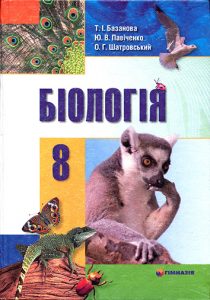
Bazanova, T. I., Pavichenko, Yu. I., Shatrovskiy, A. G. (2008) Biology: Tutorial for 8th grade general comprehensive schools. Kh.: Gymnasium. 320 p. (In Ukrainian)
My participation was not very significant, but was a real. And what’s happened? Well, a textbook is like a textbook. Not the worst, but …